Showing posts with label Owen Wilson. Show all posts

Friday, December 30, 2011

'ALLINOL' INDEED!


DIRECTED BY JOHN LASSETER
WITH THE VOICES OF OWEN WILSON, LARRY THE CABLE GUY, MICHAEL CAINE, EMILY MORTIMER, BONNIE HUNT, JOHN TURTURRO, EDDIE IZZARD, JASON ISAACS, THOMAS KRETSCHMANN, JOE MANTEGNA, PETER JACOBSON, TONY SHALHOUB, GUIDO QUARONI, PAUL DOOLEY, JOHN RATZENBERGER with JEFF GORDON, LEWIS HAMILTON and VANESSA REDGRAVE

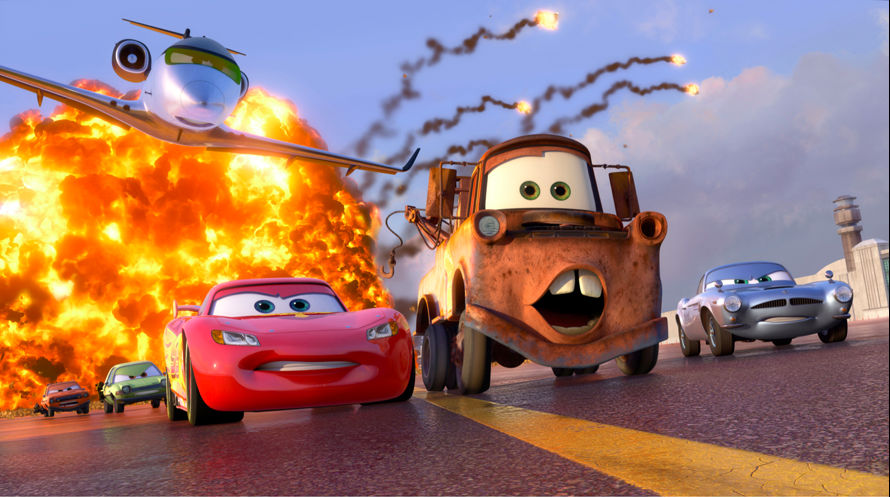
Cars 2’ is not a film that can pause to answer if you ask it to explain itself. It’s not futile to ask that; it’s mindless. It’s something the film sidesteps on its race ahead. Lightning McQueen (Owen Wilson) could have had a hand in the ‘Toy Story’ franchise playing grease-man in Operation Rescue-Woody. Same goes with Mater (Larry the Cable Guy). These are two cars with as much utility as depth in character. Their presence would make an ‘Ocean’s Eleven’ out of ‘Toy Story’ centered on a moral bailout. With them, you could’ve had more effective, much more diversified action that would pacify the Hot-Wheels-Kid as much as the Teddy-hugger; the Action-figure bully as much as the Barbie doll. They’re universal, in short.

And yet we find that John Lasseter, the man behind Pixar Animation Studios in both heart and mind, prefers to write a movie for them than make one out of them. And then a second. We ask why. Chinese food in China is ‘food’ where you can tell good from bad. Doc. Hudson in ‘Toy Story’ could have been the ‘Wise Old Hornet.’ With ‘Cars’, he became a character. He played Mickey to McQueen’s Balboa. Now we hear he’s no more.

It’s been five years since the film that portrayed people in ‘Cars’ in a mix of oil and water as thick as blood. It’s been sixteen since the one that built on the question of “what if your Toys could talk?” With Pixar, it has ever been a magical journey, through tall stories as a consequence of a heightened imagination that nurtures the same. They’ve had the means, they’ve had the method. They’ve got the wildness that gives means to the method. There’s no story untellable, no dream too far.

There’s none like Pixar that understands the concept of an animated feature. It’d only take you a look at the chronology with Pixar contributions to see what I’m saying. The ‘Toy Story’ series. ‘Monsters Inc.’ ‘Finding Nemo.’ ‘Cars.’ ‘the Incredibles.’ ‘Ratatouille.’ ‘WALL-E.’ Startlingly original stories brought to life with the help of computer-generated imaging. The animation is but an accessory to the storytelling, it’s the brain that dazzles. Its complexity is not evident, its joints not seen. All that shows is an organic whole, taking off with astounding precision. With Pixar studios, it’s all about the baby without fuss on the miracle of conception. They’re like a real force of nature that way.

‘Cars 2’ is no different. It’s an espionage routine set on a racing circuit with oil tycoons and an alternate energy bubble. A comprehensive turn of events fit into a framework that actually provides scope for questioning – how many films are we having to take for granted these days? ‘Cars 2’ is an exciting break from that drill. You accept the very basic premise and you get to savour the storyline, its logic intact. This world is nothing but talking cars, talking ships, talking 747s and helicopters. Fuel and water turn delicacies, the Big Ben is called the ‘Big Bentley’ with windows shaped like radiators. Dying is but engine-burst where people are cars. Like Lewis Hamilton. Like Finn McMissile (Michael Caine) who is sort of an Aston Martin, James-Bond-styled. If there was to be a superhero, it’d be the Batmobile. Or Mater.

There’s something very special about ‘Cars’ and its sequel. These are the only films that have had Lasseter involved in the creative process. Films that he’s directed, films he’s conceived. The others, he’s executive-produced. In Lasseter, I draw a Judd Apatow comparison. That he saves only the best for himself. By ‘best’, I mean the ‘closest to heart.’ Films that he simply cannot let pass. Films that, undeniably, are HIS. It’s uncanny, his eye for detail. The setting, the characters, the voice-acting, the little nothings you’d probably not even notice and the consistency in the same. It’s amazing how his cars are both real and yet extremely imaginative at the same time. They’re ‘intricately-detailed-characters’ taken a little too literally. Every single one of them is loveable. They all grow on you. Even the Queen (Vanessa Redgrave) – the ‘Shakespeare in Love’ sort of cameo by an equally exciting actress.

McMissile calls Mater ‘the smartest, most honest chap he’s ever met.’ Holly Shiftwell (Emily Mortimer) adds ‘most Charming’ to the list. ‘Cars 2’ calls for similar praise. It’s pure celebration that never runs dry. The only thing that’s missing would be a dance-routine. And I would watch a third film just for that.

Saturday, November 26, 2011

'HALL PASS' OR THE ABUSE OF ONE


DIRECTED BY THE FARRELLY BROTHERS
STARRING: OWEN WILSON, JASON SUDEIKIS, JENNA FISCHER, CHRISTINA APPLEGATE, NICKY WHELAN, ALEXANDRA DADDARIO, STEPHEN MERCHANT, JOY BEHAR, LARRY JOE CAMPBELL and RICHARD JENKINS

The Farrelly Brothers have the inimitable knack of giving you a less-than-perfect version of their film. I don’t know why they do it, but they do it. They’re champions at it. They’re like kings at blue-balling people. All their films have a remarkable central agenda which they address (and fairly well at that) as much as their self-induced cheapness permits them to. ‘Shallow Hal’ dealt with a man’s inherent dread of going with a ‘less-than-attractive’ woman. They chased high-school love in ‘There’s Something about Mary’; even ‘the Heartbreak Kid’ was on a middle-aged man’s discontent about his relationships.

No, I’m not trying to romanticize their work over here. I’m actually telling you how much they don’t want you to. They would do anything to make sure you don’t have fond memories of their film when you’re done watching it. Anything. You’d be amazed. They’d show you penises of different shapes and sizes and colours, they would make a full-grown man defecate in a golf bunker, they would show a woman do the same on a bathroom wall and have someone ogle at it like it were artwork. I don’t know if this makes them the vilest of human beings in the world or if I’m just not a sport because I don’t take their shit. Literally.

Or I don’t know if they’re masters at pastiche who make you laugh your gut out one second and then trigger the same reaction the next, except it’s not out of laughter this time. They’re disengaging with such deliberation. It’s like they’re on a mission.

What’s even worse is that they do these things to really likeable people. And characters. You could put Jason Sudeikis in a sticky situation like this, but not Owen Wilson. Maybe Jeff Anderson, but not Seth Rogen. You see what I’m saying? Or maybe it’s just me. I thought ‘Horrible Bosses’ had it right in that it kept aside the best of its disengaging humour to Sudeikis and a little of Charlie Day but never Bateman. Because he just wouldn't do. He wouldn’t have been appropriate to be in an inappropriate position. Neither was Owen Wilson, I thought. Of course, I find that I’m talking more people than characters here. In my defence, the film stuck to their usual screen-selves. It was a Steve Coogan thing once. I guess it should be called a ‘Sudeikis thing’ from now. He’s the one who’s typecast more. Coogan at least has ‘Night at the Museum’ to his credit.

‘Hall Pass’ is about Rick Mills (Wilson) and Fred Searing (Sudeikis) who are given a ‘hall pass’ by their wives Maggie (Jenna Fischer) and Grace (Christina Applegate) respectively. A ‘hall pass’, as we learn, is a week of freedom from marriage extended to a man by his wife to let him accomplish everything that he believes his marriage is keeping him off from. Or find that he can’t. In Rick and Fred, we have two kinds of men – one who’s disappointed that he can’t pick up other women and one who wants to. It’s much like the difference between Maggie and Grace themselves. Maggie finds she wanted a break from her marriage. Grace finds use for one. The two couples are written in stone on this script that wants them to get back together in this road trip towards each other.

There are no collisions, no discomforts. There is absolutely no irreparable damage. Nothing happens to the two couples to alter their courses even by an inch, the most disturbing event in one’s married life passes off as a beer joke. On the one hand, I was startled at how easily the Farrelly brothers could take in the premise (conceptualized by Pete Jones). On the other, I was annoyed at how easily they threw it away and how their film played along like a shameless farce. It was like double-indemnity but the contextual opposite. And what can make it worse? A Grand Theft Auto with the police involved and a psycho in the middle who simple had to be there. And a hospital scene. Yes, it had it all.

‘Hall Pass’ thus, like every Farrelly fare, is an idiot’s treatment of a serious premise involving characters who deserve more. There’s more happening with these people than what they show you, what’s going on is not just what they say is going on. There’s more to the film than what you just saw, something its makers can’t handle. A stronger film would have had a confrontation saying “Whose Hall Pass is it? Yours? Or mine?” This one drops a line at best. But hey, at least they mentioned it! It’s that line that saved some face. Without it, we’re talking reimbursement. Of time and energy lost in deliberate ‘stupid.’

Thursday, September 8, 2011

TO PARIS, WITH LOVE


DIRECTED BY WOODY ALLEN 
STARRING: OWEN WILSON, RACHEL McADAMS, KURT FULLER, MIMI KENNEDY, MICHAEL SHEEN, NINA ARIANDA, ALISON PILL, COREY STOLL, KATHY BATES, CARLA BRUNI, LEA SEYDOUX, GAD ELMALEH with ADRIEN BRODY and MARION COTILLARD 

Midnight in Paris’ opens with snapshots of the city that looks to shy away from its own romance. Woody Allen’s nostalgia shop thus cranks open, the sequence being his dry remark not just on the city but of present day in itself. It’s also strenuously long, and in that it tests the viewer on his fondness towards the metropolis that its writer so rejoices in. Three years after, Woody Allen arrives with a follow-up to his sexually, metaphorically aggressive ‘Vicky Cristina Barcelona’. Only this time, we find it’s even more about the city than just the things that happen in it; we find it’s more about the author than just his concept. We gear up, we’re excited. It’s an autobiography of a fantasy in a trip that goes farther back than his memory lane, delving in dreams on alleys and cabs and jazz bars and dark little corners of sweet little nothings. 

Gil Pender (Owen Wilson) is Woody Allen dyed blonde after a possible corrective eye-surgery. He's also taller, more coherent and less of an outrage, though he looks a little too worse for wear. Minutes into character, we find how convenient it is to have cast the seasoned comedian in Wilson, who both cheekily matches Allen’s usual peccadillos as well as establishes his own prowess in playing the quintessential overgrown adolescent. His performance is clear-cut and fulfilling, maybe a tad too reminiscent, but it’s all good – it adds to the strength of a plot somehow reinforces itself with every little detail it provides. We have the Allen (in his more recent films) stereotype in Inez (Rachel McAdams), of a woman who likes her fiancĂ© but not enough to stick to him. We have the disapproving parents, the art confrontation and an emasculating counterpart in Paul Bates (Michael Sheen) all too soon. In Sheen, we have yet another actor who seems to have mastered the Allen School of acting and dialogue delivery, a consequence of which we find ourselves struck by a cascade of performances that are only too faithful to the eccentric master. Kathy Bates is her usual, domineering self, Marion Cotillard as Ariadne, the woman of Gil's dreams, proves to be a true Diva of this generation. Allen has always loved the enemy enough to create crushing opponents to shower unrequited love upon, right from his decisive 'Annie Hall'. His Ariadne helps Gil find his way back to a reality away from dreams, a character detail that strongly coheres with Cotillard's portrayal of Mal in Christopher Nolan's 'Inception'. The name Ariadne rings a bell as well, although it was another character that was named so. Too much of a coincidence?

On the one hand, we have the dowdy, lost-for-life soul-searcher in Gil, our hero. On the other, there’s the man with the touch of gold in Paul. Allen’s women have never required reason to depart, while it usually takes him the entire length of his films to deem as futile his efforts on finding one. It’s strange how it’s both sad as well as incredibly delightful to watch the man retract to his once-wide-eyed longing for both closeness as well as closure. In his silence is a cry for help, his contentment a fantasy. And who can lend a stronger hand to lift to clarity than the prosaic representation of strength in agony of Hemingway (Corey Stoll) himself? 

“All cowardice comes from not loving, or not loving well, which in essence is the same thing.” The quote pertains to the film as well. I loved it. I’m loving it. I will love it more, but not just to deem myself brave. When did we last see Woody Allen fall in love? Was it when he drowned in the emotional seductiveness of Dianne Wiest’s Holly in ‘Hannah and her Sisters’? Or when he coveted the unattainable Halley Reed in ‘Crimes and Misdemeanors’? ‘Deconstructing Harry’ had him deconstruct plausibility of emotions in an effort at catharsis that he largely accomplished. ‘Everyone says I Love you’ was an even obvious satire and he followed it up with comedies and mysteries and this and that. In that hierarchy, ‘Midnight in Paris’ is a lost-fantasy; a reinvention. It’s a diary found in the attic of his middle-aged residence that’s but full of dreams and recollections of things that he wished had happened to him. It’s a treasure chest that opens to every viewer irrespectively, and offers as reward their very own needs. 

Some people chisel, some people sculpt. Woody Allen just seems to have touched the city of Paris with a touch of life. He walks in the rain without an umbrella and paints the town in his shade with the water that drains off him. The quirky little man has a taller, blonde and stranger version in a delightful misrepresentation with the effect unhindered. And the two of them set out, stretching their feet, singing a song of their own called ‘to Paris, with Love’. With that, they have her bowled over. Much like me, much like you too.